Preparing & Testing Concrete Cylinder Molds
Concrete strength testing begins before a cylinder reaches the compression-testing machine. The condition of the mold, the way the specimen is prepared, and its handling and curing can all influence the final result.
M.A. Industries manufactures single-use plastic cylinder molds designed to maintain their shape during filling, consolidation, initial curing, and transportation. Available configurations include cylinder molds with attached lids, which help simplify specimen protection and identification after molding.
Testing M.A. Industries Cylinder Molds
In the following video, Kyle Turner demonstrates testing performed on M.A. Industries concrete cylinder molds.
The demonstration provides a practical look at the durability and performance characteristics that matter in the field. A cylinder mold must withstand filling, rodding or vibration, tapping, handling, and initial curing without splitting, leaking, or losing its intended dimensions.
ASTM C470/C470M covers molds used to form cylindrical concrete specimens. The specification addresses both reusable and single-use molds and requires molds to form right circular cylinders with the prescribed dimensional relationship. Single-use molds may be manufactured from plastic, sheet metal, treated paper, or other suitable materials.
Why Cylinder Mold Quality Matters
A concrete test cylinder is intended to provide useful information about the concrete it represents. If the mold leaks, deforms, absorbs water, or is damaged during consolidation, the resulting specimen may no longer accurately represent the sampled concrete.
An appropriate cylinder mold should:
- Maintain its shape during filling and consolidation
- Rest securely on a firm, level surface
- Resist leakage during specimen preparation and initial curing
- Be made from a material that does not react with the concrete
- Withstand normal rodding, tapping, handling, and transportation
- Produce a specimen with the required dimensions and cylindrical form
- Protect the specimen against moisture loss during initial curing
Federal Highway Administration training materials state that molds should be manufactured from non-absorbent materials that do not react with concrete. They must retain their dimensions and shape during use and comply with the applicable requirements for elongation, absorption, and water leakage.
Standards Applicable to Concrete Cylinder Molds and Specimens
Several standards work together to address the mold, preparation of the specimen, curing, and strength testing.
ASTM C470/C470M and AASHTO M 205
ASTM C470/C470M and AASHTO M 205 establish requirements for molds used to form concrete test cylinders vertically. ASTM C470/C470M covers both reusable and single-use molds, including plastic molds.
These specifications address characteristics such as:
- Mold construction and materials
- Inside dimensions
- Cylindrical shape
- Dimensional stability
- Water leakage
- Absorption and elongation, when applicable
- Resistance to damage during normal use
M.A. Industries single-use cylinder molds are manufactured for applications requiring compliance with ASTM C470/C470M and AASHTO M 205.
ASTM C31/C31M and AASHTO T 23
ASTM C31/C31M and AASHTO T 23 cover making, curing, protecting, and transporting concrete test specimens under field conditions. Properly prepared and standard-cured cylinders may be used for concrete acceptance testing, mixture evaluation, and quality control.
ASTM C39/C39M and AASHTO T 22
ASTM C39/C39M and AASHTO T 22 cover compressive-strength testing of cylindrical concrete specimens. These standards apply after the cylinder has been molded, cured, transported, prepared, and placed in a compression-testing machine.
The testing laboratory should always follow the current edition of each applicable standard and any additional project, agency, or state DOT requirements.
Checking a Cylinder Mold Before Use
Before filling a cylinder mold, inspect it for conditions that could affect the specimen.
1. Inspect the mold for damage
Check the mold body, base, rim, and lid. Do not use a mold that is cracked, punctured, badly distorted, or otherwise damaged.
The mold should stand vertically on a firm, level surface without rocking. Its base should remain stable during filling and consolidation.
2. Confirm the correct mold size
Select the mold size required by the testing procedure and project specification. Common concrete cylinder sizes include:
- 4 × 8 inches
- 6 × 12 inches
Other sizes may be appropriate for specialized materials or testing programs. The selected specimen diameter must also be appropriate for the nominal maximum size of the aggregate.
3. Check the interior
The inside of the mold should be clean and free of foreign material. Because a single-use plastic mold is designed to release the hardened specimen, a release agent generally should not be added unless the applicable procedure or laboratory policy specifically requires one.
4. Prepare identification
Create a clear identification system before filling the molds. Depending on the project, records may include:
- Project or contract number
- Sample identification
- Concrete placement location
- Date and time sampled
- Truck or batch number
- Mixture identification
- Specimen number
- Intended test age
- Technician’s name or initials
- Curing method
Avoid writing only on a removable lid unless the mold body or accompanying records carry matching identification.
How Single-Use Cylinder Molds May Be Verified
Quality-control testing of an empty mold is different from making a concrete test specimen. Verification procedures may examine whether the mold can withstand expected use while retaining its shape and resisting leakage.
A North Dakota Department of Transportation verification procedure for single-use plastic molds includes the following general evaluations:
- The mold is filled in three layers with dry coarse aggregate.
- Each layer is rodded 25 times.
- The aggregate is removed and the mold is examined for physical damage.
- Initial mold dimensions and weight are recorded.
- The mold is placed on a firm, flat surface and filled approximately 90% to 95% with room-temperature water.
- Its height is measured and the mold is allowed to stand for three hours.
- The mold is checked for visible leakage, dimensional change, and other damage.
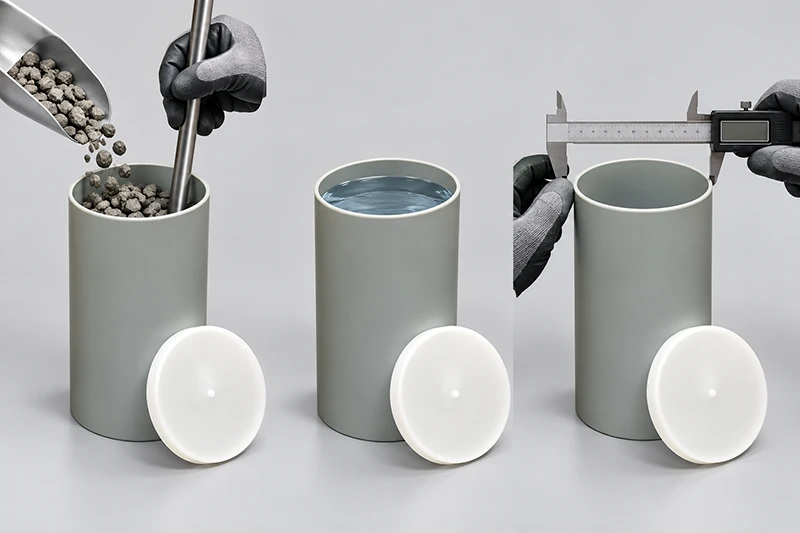
For plastic molds, the agency procedure specifically calls for checking strength and water leakage. Acceptance tolerances are taken from AASHTO M 205.
This type of verification helps evaluate whether a mold can tolerate rodding and retain liquid without splitting, leaking, or undergoing unacceptable dimensional change. It should be performed according to the governing standard or agency procedure rather than treated as a substitute for formal compliance testing.
Preparing a Concrete Test Cylinder
Once the molds have been inspected and placed on a firm, level surface, specimen preparation should follow ASTM C31/C31M, AASHTO T 23, and applicable project requirements.
Obtain a representative sample
Sample freshly mixed concrete according to the required sampling standard, commonly ASTM C172/C172M or AASHTO R 60. The sample should represent the concrete after applicable jobsite adjustments have been completed.
Complete required fresh-concrete tests—such as temperature, slump, air content, and density—within the time limits established by the applicable standards.
Select the consolidation method
The concrete sample’s slump and the applicable testing procedure determine whether the specimen may be consolidated by rodding or must be consolidated by vibration.
FHWA training guidance identifies the following general requirements:
| Concrete slump | Permitted consolidation method |
|---|---|
| 1 inch or greater | Rodding or vibration |
| Less than 1 inch | Vibration |
Project specifications or specialized concrete mixtures may require a different procedure.
Fill the mold evenly
Use a scoop of an appropriate size and distribute the concrete around the mold opening to reduce segregation. Fill the mold in the required number of approximately equal layers.
For commonly used cylinders consolidated by rodding, FHWA guidance summarizes the following requirements:
| Cylinder size | Number of layers | Rod penetrations per layer |
|---|---|---|
| 4 × 8 inches | 2 | 25 |
| 6 × 12 inches | 3 | 25 |
Use the rounded end of the correct-size tamping rod. Distribute the strokes evenly across the cross-section. When rodding a layer above the first, allow the rod to penetrate approximately 1 inch into the preceding layer.
Close consolidation voids
After each layer is rodded or vibrated, lightly tap the outside of the mold 10 to 15 times with an appropriate mallet or an open hand, as permitted by the governing procedure. This helps close any voids left during consolidation.
The mold must be strong enough to withstand this normal handling without cracking or losing its shape.
Finish the surface
After consolidating the final layer, remove or add a small amount of concrete if necessary and finish the top with minimal manipulation. The surface should be flat and level with the mold rim.
Attach the lid and verify identification
Secure the attached lid after finishing the specimen. The lid helps limit moisture loss and protects the top surface during initial curing and handling.
Confirm that the cylinder identification matches the field-testing records before leaving the sampling location.
Initial Curing and Protection
Immediately after molding, protect test cylinders against:
- Moisture loss
- Direct sunlight
- Temperature extremes
- Vibration
- Impact
- Movement or disturbance
For standard-cured specimens, FHWA’s summary of ASTM C31/AASHTO T 23 calls for an initial curing environment that prevents moisture loss and maintains a temperature between 60°F and 80°F for up to 48 hours. The requirements may be narrower for concrete with a specified strength of 6,000 psi or greater, so technicians should consult the current standard.
Do not place fresh specimens where they can be shaken by construction equipment, struck by tools, exposed to vehicle vibration, or subjected to uncontrolled heating or cooling.
Transportation, Demolding, and Final Curing
Transport specimens according to the timing and handling requirements of ASTM C31/C31M or AASHTO T 23. Protect them from freezing, moisture loss, and physical damage during transportation.
After the initial curing period:
- Remove the lid.
- Strip the single-use mold without damaging the specimen.
- Inspect the cylinder and record any visible irregularities.
- Place standard-cured specimens into the required moist-curing environment within the permitted time.
FHWA guidance describes final curing in a moist room or water-storage tank maintained at approximately 73.5°F ± 3.5°F.
Common Problems That Can Affect Test Results
Even a compliant mold cannot compensate for improper specimen preparation. Common sources of unreliable results include:
- Using a cracked, leaking, or distorted mold
- Placing the mold on an uneven or unstable surface
- Filling the mold with unequal layers
- Using the wrong tamping-rod diameter
- Applying too few or too many rod strokes
- Failing to penetrate the preceding layer
- Over-vibrating or under-vibrating the concrete
- Failing to close consolidation voids
- Allowing the cylinder to lose moisture
- Exposing the specimen to temperatures outside the required range
- Moving or transporting the specimen too soon
- Misidentifying the cylinder
- Damaging the specimen during stripping or transportation
Consistent mold quality, careful field practices, and controlled curing all contribute to concrete strength results that can be evaluated with confidence.
M.A. Industries Single-Use Cylinder Molds
M.A. Industries manufactures single-use plastic concrete cylinder molds in multiple sizes and configurations. The molds are designed for dimensional stability, durability, easy stripping, and use in concrete testing programs governed by ASTM and AASHTO requirements.
The attached-lid configuration keeps the lid with the mold during storage and specimen preparation, reducing the chance of misplaced or mismatched lids while providing convenient protection after the cylinder has been finished.
References and Additional Guidance
- ASTM C470/C470M — Standard Specification for Molds for Forming Concrete Test Cylinders Vertically
- ASTM C31/C31M — Standard Practice for Making and Curing Concrete Test Specimens in the Field
- Federal Highway Administration — Testing Fresh Concrete Laboratory Manual
- North Dakota Department of Transportation — Single-Use Concrete Cylinder Mold Verification Procedure
This page provides a general technical overview. Always use the current edition of the applicable ASTM, AASHTO, agency, and project specifications when preparing, verifying, curing, transporting, or testing concrete specimens.